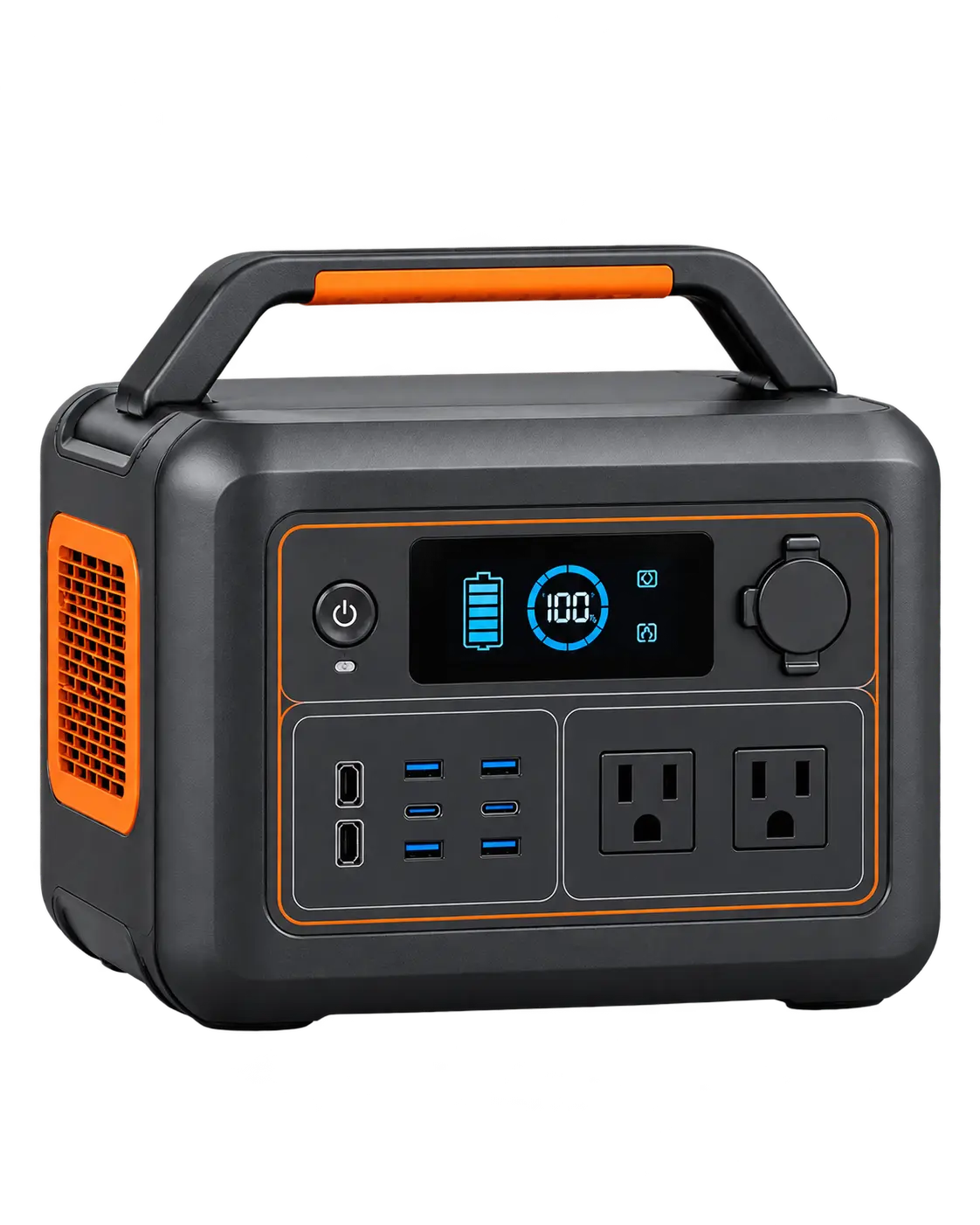
Watts vs Watt-Hours Explained (Power Station Basics)
The two most important numbers on any portable power station are watts (W) and watt-hours (Wh). Mixing them up is the most common buying mistake. Here’s the simple difference.
Quick answer
Watts measure power at a moment (how much a device draws, or how much a station can deliver). Watt-hours measure stored energy (how long the station can keep delivering). Runtime ≈ Wh × 0.85 ÷ W.
A Simple Analogy
Think of a water tank. Watt-hours are the size of the tank; watts are how fast water flows out of the tap. A big tank with a small tap lasts a long time; a big tap empties any tank quickly.
What They Mean on a Power Station
| Spec | Meaning | Example |
|---|---|---|
| Capacity (Wh) | Energy stored | 1,070Wh |
| Continuous output (W) | Max power it can deliver continuously | 1,500W |
| Surge output (W) | Short burst for motor start-up | 3,000W |
| Device rating (W) | Power a device draws | CPAP 40W |
Calculating Runtime
Runtime (hours) = capacity (Wh) × 0.85 ÷ device watts. Example: a 1,000Wh station running a 100W TV lasts about 8.5 hours. Try our runtime calculator for multiple devices.
Common Mistakes
- Buying on capacity alone, then finding the inverter can’t run a microwave or coffee maker.
- Using a fridge’s running watts instead of its average watts.
- Forgetting surge: motors need 2–3× running watts to start.
- Confusing mAh with Wh: Wh = mAh × volts ÷ 1,000.
Ready to size one? See what size power station you need and our best portable power stations.
FAQ
Is 1,000Wh the same as 1,000W?
No. 1,000Wh is stored energy; 1,000W is power output. A 1,000Wh station could deliver 1,000W for about 50 minutes or 100W for about 8.5 hours.
How do I convert amp-hours to watt-hours?
Multiply amp-hours by voltage: 100Ah × 12.8V = 1,280Wh.

