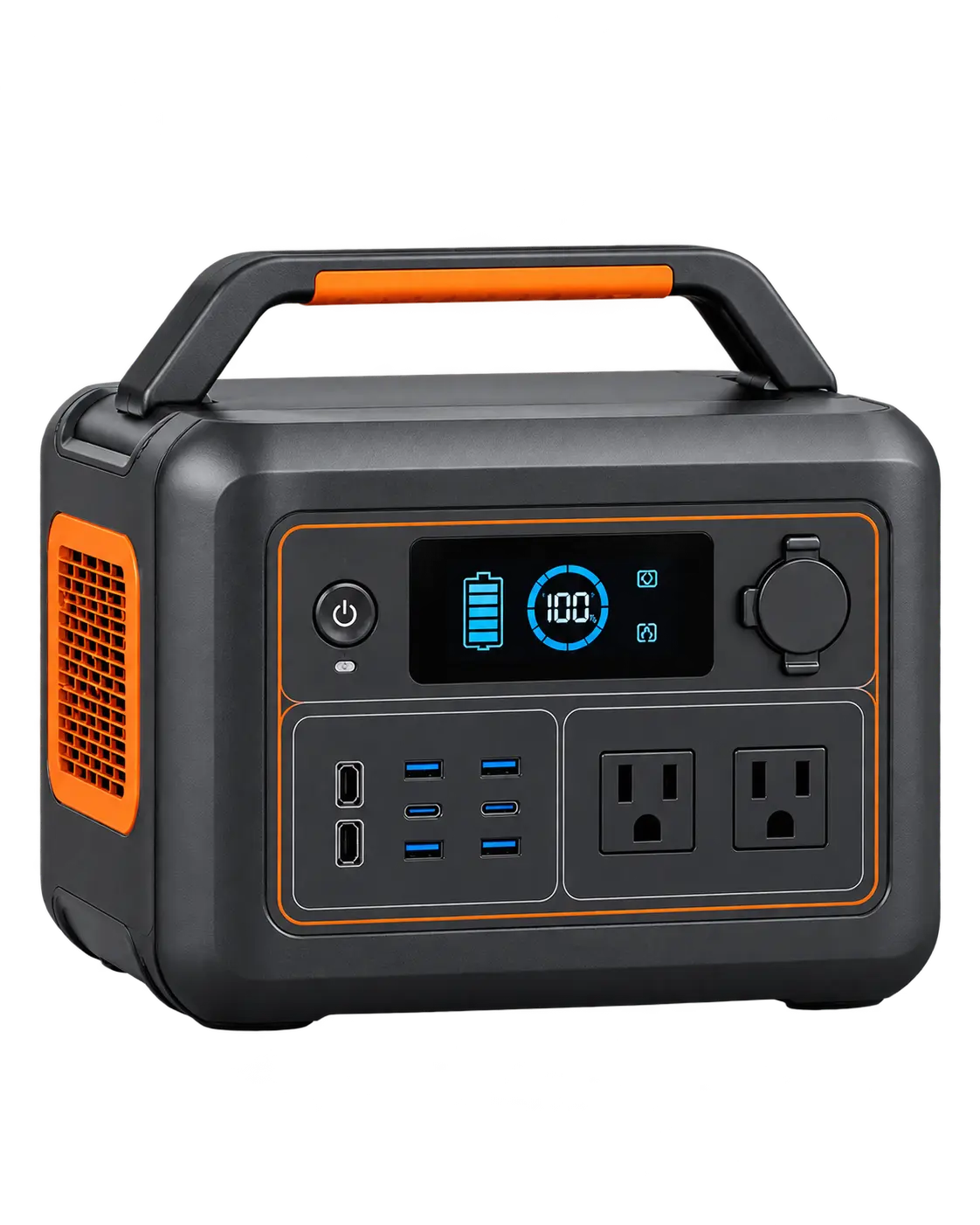
Best Portable Power Station for RV Living & Road Trips (2026)
We may earn a commission when you buy through links on this page, at no extra cost to you. Learn more.
A portable power station for RV use lets you boondock without running a noisy generator, keep the fridge and fans running, and charge laptops and phones anywhere. RVers have two good paths: a large plug-and-play power station, or a permanently installed 12V LiFePO4 battery bank. This guide covers both.
Quick answer
The Pecron E1500LFP is our favorite RV power station: 1,536Wh, 2,200W, 800W solar input and expandable to 7,680Wh. For bigger rigs, the Aferiy P310 scales to 11,520Wh. If you want a permanent house battery, the Vatrer 12V 300Ah packs 3,840Wh into one battery.
Best Portable Power Stations for RVs
Best overall for RVs: Pecron E1500LFP
The buy-once, grow-later pick. At 1.5kWh it suits RVs and camping, and two EP3000 expansion batteries take it to 7,680Wh for serious home backup. The 800W solar input is excellent for its size, and Pecron rates the battery for 3,500+ cycles with a 2+3-year warranty.
✔ Pros
- Expandable from 1.5kWh to 7.7kWh
- 2,200W inverter with 4,400W surge
- 800W solar input
- ~1.8-hour fast AC charging
✖ Cons
- Expansion batteries add significant cost
- Heavier than 1kWh rivals
Best for: RVers, van-lifers and anyone who wants to start small and scale up.
Best for big rigs & full-timers: Aferiy P310
Starts at a huge 3,840Wh and scales to 11,520Wh with add-on batteries, enough for a fridge, freezer, lights and internet for several days. Its sub-10ms UPS switchover keeps computers, routers and medical devices running when the grid drops.
✔ Pros
- Massive capacity, expandable to 11.5kWh
- Fast UPS switchover
- Built for multi-day outages
✖ Cons
- Large and heavy; it stays in one place
- Expansion batteries add cost
Best for: multi-day outages, off-grid cabins and home offices.
Best plug-and-play 2kWh: Jackery Explorer 2000 v2
Double the capacity of the 1000 v2 in Jackery’s familiar ecosystem. A strong all-rounder for RV trips and for keeping essentials running through a day-long outage.
✔ Pros
- Trusted brand and support
- 2kWh LiFePO4 battery
- Frequent deep discounts
✖ Cons
- Lower output than the similarly sized Aferiy P210
- Heavier to carry than 1kWh units
Best for: buyers who want Jackery reliability with around 2kWh of storage.
Best value for weekend RVers: Aferiy P210
2kWh of capacity and a 2,400W inverter at a value-focused price. Independent reviewers report that it stays stable under heavy loads, and combined AC + solar charging refills it in about an hour and a half.
✔ Pros
- Big capacity and output for the money
- Very fast combined charging
- 4,800W surge for fridges and tools
✖ Cons
- Smaller brand, fewer US service options
- Heavier than 1kWh units
Best for: budget-minded home backup, RV weekends and job sites.
Read our full Aferiy P210 review.
Prefer a Permanent RV House Battery?
If you’re comfortable with (or will pay for) wiring an inverter and charge controller, a 12V LiFePO4 house battery offers the lowest cost per watt-hour and integrates with your RV’s 12V system. Read our full power station vs LiFePO4 battery comparison.
Best high-capacity house battery: Vatrer 12V 300Ah LiFePO4
3,840Wh in a single 12V battery, built for RV and solar house banks. One battery replaces three 100Ah units and simplifies wiring.
✔ Pros
- Huge capacity in one battery
- Fewer connections than parallel banks
- Low-temperature protection
✖ Cons
- Heavy
- Requires a properly sized inverter, charger and cabling
Best for: full-time RVers and off-grid solar systems.
Best compact battery for vans: WattCycle 12V 100Ah Mini
A genuinely compact 100Ah battery that fits tight spaces in vans and small RVs. The Bluetooth version shows state of charge in an app, and independent testers have praised its measured capacity.
✔ Pros
- Very compact for 100Ah
- Optional Bluetooth monitoring
- Strong value
✖ Cons
- Needs your own inverter and charger
- Cold-weather charging cutoff
Best for: vans, small RVs and tight battery boxes.
Sizing a Power Station for RV Loads
| RV load | Typical draw | Notes |
|---|---|---|
| 12V RV fridge (compressor) | 40–80W avg | Runs well from DC |
| Roof vent fan | 20–40W | Major comfort upgrade |
| LED lights | 10–30W | Minimal impact |
| Laptop / TV | 50–100W | Use AC or USB-C |
| Microwave | 1,200–1,500W | Short bursts only |
| 13,500 BTU rooftop AC | 1,300–1,800W running, high surge | Needs a large unit and soft-start; runtime limited |
Most RVers boondocking for a weekend do well with 1,500–2,000Wh plus 400–800W of solar. Full-timers who run a microwave daily, or want limited AC use, should look at 3,000Wh+ expandable systems.
See our complete guide to the best portable power stations for home backup and camping picks.
RV FAQ
Can a portable power station run an RV air conditioner?
Only a large one, and only for a limited time. A 13,500 BTU rooftop AC draws 1,300–1,800W running and much more at start-up, so you need 3,000W+ output (or a soft-start kit) and a big battery. Expect a few hours, not all night.
Can I plug my RV into a power station?
Yes, if the power station has a TT-30 outlet or you use the correct adapter, and the unit’s output exceeds your RV’s running load. Turn off high-draw appliances like the AC and water heater first.
Power station or generator for RV?
Power stations are silent and allowed during quiet hours; generators provide unlimited runtime with fuel. Many RVers pair a power station with solar and keep a small inverter generator as backup.


